






Croatia’s double winners stand in PAOK’s way
Four years ago, PAOK met Riejka in the Conference League Play Offs, this time it’s the Europa League Play Offs. The Double-headed Eagle are called upon to once again overcome the obstacle of the Croatians, who are coming into the tie on the back of one of the club’s most successful seasons, since Riejka won the domestic double for the second time in their history.
In one of the most competitive league seasons in recent years, Rijeka came out on top and won the league title, level on points with Dinamo Zagreb but with a better goal difference. Third, two points behind, were Hajduk Split. Rijeka also won the Croatian Cup, beating Slaven Melupo.

- This summer started with the Champions League qualifiers for Riejka. They were eliminated by Ludogorets in extra time (3-1) and then in the 3rd qualifying round of the Europa League they eliminated Shelbourne with a 4-3 aggregate score.
- After a two-year stint as assistant, 42-year-old Montenegrin Radomir Dzalović took over as head coach last year and won the double. After 38 matches, he has 19 wins, ten draws and nine losses.
- Among the nine transfers that Rijeka has made is former PAOK midfielder Thiago Dantas.
- PAOK met Rijeka in the 2021-22 season in the Conference League Play offs. On 19.08.2021 the two teams drew (1-1) in Thessaloniki and in the second leg in Croatia PAOK qualified, winning 2-0 (El Kaddouri and Murg).
- The club was founded on 21 April 1904 as Club Sportivo Olimpia by Italians and Croats, at a time when Rijeka was part of the Austro-Hungarian Empire. Initially, it included swimming, cycling, track and field and boxing teams, while on 25 November 1906 a football team was added.
- The team, completely affected by the turbulent political changes that swept the city of Rijeka, changed its name to U.S. Fiumana in 1926 (a date that some refer to as the team’s birthday), to S.C.F. Quarnero in 1946, to NK Rijeka in 1954 and finally to HNK Rijeka in 1995.
- In fact, in 1926, as U.S. Fiumana, it joined the Italian Serie C (and later Serie B), since the wider area of Fiume, where the city is located, belonged to Italy.
- Most of Fiumana’s players joined the guerrilla movement and helped the Yugoslav liberation movement, with many ending up in prison and concentration camps.
- After the end of World War II, Fiume joined Yugoslavia, the city and the team were renamed Rijeka and started the 1946-47 season competing in the first division, until 1992 and the dissolution of Yugoslavia.
- After the dissolution of Yugoslavia in 1992, Rijeka joined the Croatian First Division. In 1995, the club changed its name to HNK Rijeka. Rijeka remains one of the four founding members of the Croatian top flight that have never been relegated.
- Rijeka’s successes during the Yugoslav era were few and far between, with two Cups (1978, 1979) and one Balkan Cup (1978). They came closest to winning the Yugoslav championship in 1984, when they finished two points behind Red Star.
- After Croatia’s secession and independence from Yugoslavia in 1991, they began to excel in their country’s league. With two championships (2017, 2025) – both seasons they won the double, by the way – seven cups (2005, 2006, 2014, 2017, 2019, 2020, 2025) and one Super Cup (2014), they are the third team in terms of victories after Dinamo Zagreb and Hajduk Split. It should be noted that in 2017, they ended Dinamo Zagreb’s streak of 11 consecutive titles.
- They have participated in UEFA competitions a total of 25 times, including 13 consecutive appearances since 2013–14.
- Their most memorable result in Europe was the home win (3–1) against eventual winners Real Madrid in the 1984–85 UEFA Cup. It is worth mentioning, however, the story behind Real’s 3–0 win at the Bernabéu, which gave the Spanish team qualification. Real scored their first goal from a controversial penalty in the 67th minute, and after Rijeka were playing with ten men. In the next ten minutes, two more of their players were sent off, with Damir Desnica’s dismissal remaining … unforgettable. First yellow for not stopping the game after the referee had already blown the whistle, and a second yellow for allegedly insulting him. Desnica was deaf. Real scored twice more, qualified and eventually won the trophy.
- Their biggest success was the quarter-final of the 1979–80 European Cup Winners’ Cup, where they lost to Juventus with a 2–0 aggregate score.
- In the 2021–22, 2023–24 and 2024–25 seasons, Rijeka were eliminated in the UEFA Conference League Play Offs.
- Rijeka’s most expensive sale was that of Andrej Kramarić in 2015, who was bought by Leicester for £9.7 million.
- Rijeka’s biggest rivalry is with Hajduk Split.
- Their colours are white, blue and gold.
The Stadion Rujevica is their temporary home

The team’s official website features a tribute to the dream of a new stadium in Rijeka’s historic home. Until then, of course, the team plays at Stadion Rujevica, where it will host PAOK on August 21.
- Kantrida was the club’s traditional home for more than 95 years (with a brief break between 1947 and 1951 due to renovations) until July 2015.
- Since August 2015, Rijeka has been based at the newly built Stadion Rujevica, a modern stadium with a capacity of 8,279 seats.
- Stadion Rujevica opened its doors on August 2, 2015 (with the match Rijeka-Lokomotiva Zagreb 3-1), after an investment of 24 million euros and in July 2017 its seats were expanded.
- Its construction, which was carried out through a public-private partnership, with the participation of HNK Rijeka and the city, which held a 30% stake, took very little time. Exactly 321 days from the start of construction!
- After the club moved to Rujevica, plans emerged for the construction of a new, state-of-the-art Stadion Kantrida. The project had been on hold for almost a decade, as the club sought funding and co-investors to make the project viable.
- According to the plans, the new Kantrida stadium will accommodate 12,000 to 14,000 spectators and will meet UEFA fourth-tier standards.
Colorful Riejka

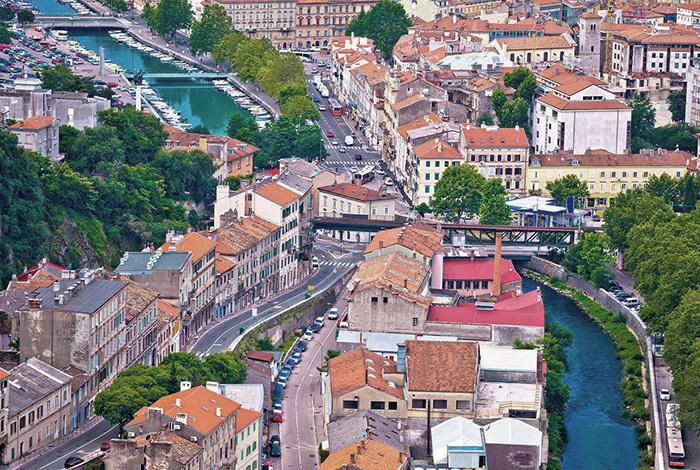
Romans and Venetians, Austro-Hungarian architecture, Yugoslav influences and the cosmopolitan aura of the Adriatic, compose the particularly colorful blend that is Rijeka on the Dalmatian coast, which PAOK will visit again in their bid to qualify for the League Phase of the Europa League.
- Rijeka is the main port of Croatia and its third largest city with approximately 200,000 inhabitants, with a thriving economy based on maritime transport, shipyards and tourism.
- The name of the city (Rijeka according to the Croats, Fiume according to the Italians) means river, as it is built on the bank of the Riječina River.
- The city has a long and turbulent history. It passed from the Franks to the Croats and the Magyars, until 1466 when it came under Austrian rule. After World War II it passed to Italy and then was ceded to the Yugoslavs and Tito, at which point the Italian population was effectively expelled.
- The most beautiful view of the city can be admired from the Church of Our Lady of Trsat, located in the castle of the same name. The “miraculous” icon of the Virgin Mary is believed to have been painted by the Evangelist Luke.
- A museum and a club at the same time, Peek&Poke is dedicated to the early days of computers and electronic games. You can see around 2,000 consoles, computers and electronic games.
- The magnificent old neo-Renaissance building Guvernerova Palača was built at the end of the 18th century as an administrative palace. The palace was designed by the leading Hungarian architect Alajos Haussmann.
- The Capuchin Church of Our Lady of Lourdes (Kapucinska Crkva) began construction in the early 1900s to mark the 50th anniversary of the miracle of Lourdes.
- Another magnificent church, in the Baroque style, is the Cathedral of St. Vitus, in the heart of the old town. The church is adorned with a cross from the 13th century.
- The seaside promenade Korzo with many shops and cafes is very… colorful and particularly lively.
- The University of Rijeka was founded in 1632.
- The Plitvice Lakes National Park, one of the natural highlights of Croatia, is two and a half hours away from Rijeka.
- Among other things, Rijeka is famous for its carnival, but also for its gastronomy.
- Even closer, about half an hour away, is the wonderful seaside town of Opatija.